Most kids don't struggle with math because it's too hard. They struggle because symbols on a worksheet arrive before the ideas those symbols stand for. Hands-on math activities fix the order: they let a child see and touch a quantity first, so the numbers on the page finally mean something. Below are the activities we reach for most, grouped by age, plus the reusable tools that turn a good afternoon into a daily habit.
What are hands-on math activities, and why do they work?
Hands-on math activities teach number concepts through physical objects and movement rather than screens or repetitive worksheets. Think grouping buttons into tens, building a number with base-ten blocks, or solving a fact on a wipe-clean chart and checking it on the spot.
They work because of how young brains learn quantity. Children grasp "how many" concretely long before they can manipulate abstract symbols, so a physical representation gives the symbol something to attach to. Researchers describe mathematical proficiency as five intertwined strands, not just getting the answer, but understanding why, and hands-on work is where conceptual understanding gets built (National Research Council, Adding It Up).
The practical version of this is the concrete → pictorial → abstract sequence:
- Concrete, the child groups ten craft sticks with a rubber band.
- Pictorial, the child draws the bundle and the loose ones.
- Abstract, the child writes "13" and reads it as "one ten and three ones."
Skip straight to step three and you get memorization that evaporates. Move through all three and the idea sticks.
What hands-on math activities work best at each age?
The best activity is the one matched to where the child is, not their grade label. Here's how we sequence it:
| Age / stage | What to build | Hands-on activities |
|---|---|---|
| 3-5 (preschool) | Counting & one-to-one correspondence | Count snack pieces onto a placemat; sort buttons by color; "how many" scavenger hunts |
| 5-7 (K-1) | Number sense & place value to 100 | Base-ten straws in bundles of ten; number-line hops; dry-erase ten-frames |
| 6-8 (1-2) | Addition & subtraction fluency | Fact families on a wipe-clean chart; dominoes; measuring-cup "how much more" |
| 8-11 (3-5) | Multiplication, division & fractions | Arrays with coins or tiles; folding paper into fractions; skip-count on a hundreds chart |
If you only remember one rule: let the tool go away gradually. Kids should reach for objects when a problem is new and lean on them less as the idea becomes automatic. That fade is the goal, not a sign you're behind.
How do you teach place value with hands-on tools?
Place value is the single idea most worth teaching by hand, because our entire number system rests on it. Do it in four moves:
- Bundle to see a "ten." Have the child count out ten small objects, straws, beans, linking cubes, and physically bundle them. Ten separate things become one group. That's the whole concept, made visible.
- Trade, don't just count. Play a "make a ten" game: every time loose ones reach ten, trade them for a bundle. This is regrouping (carrying) before it's ever a written rule.
- Say the number three ways. "Twenty-three" = "2 tens and 3 ones" = the digits 2 and 3. Naming all three builds the bridge to the written form.
- Anchor it with a reference. Keep a place-value chart visible so the child can self-check. This is where a reusable chart earns its place, more on that below.
How do you build number sense without worksheets?
Number sense, a flexible, intuitive feel for how numbers relate, comes from talking and doing, not from filling in blanks. Swap the worksheet for these:
- Subitizing flashes. Show a handful of dots or fingers for one second and ask "how many?" without counting. It trains instant quantity recognition.
- Estimation jars. Guess the number of pom-poms, then count to check. The gap between guess and answer is the learning.
- Everyday number talks. "We need 8 cups but only have 5, how many more?" Cooking, setting the table, and shopping are number sense in disguise.
- Dry-erase reps. Ten quick problems on a wipe-clean surface, wiped and repeated tomorrow, beats a printed page that gets done once and recycled.
The through-line: kids should be generating answers and reasoning out loud, not just recording them. Our screen-free approach to map skills uses the same principle, do the thinking with your hands first.
How do you teach fractions with hands-on activities?
Fractions become intuitive when kids can fold, cut, and share them before they ever see a numerator over a denominator. The idea a fraction represents, equal parts of a whole, is almost impossible to grasp from a symbol alone, which is exactly why fractions are where so many kids stall.
Start concrete, in this order:
- Fold paper. Fold a strip in half, then the halves into quarters. The child sees that "one half" and "two quarters" cover the same space, equivalence, by hand.
- Share real things. Split a snack, a set of blocks, or a paper pizza among 2, then 3, then 4 people. "Fair shares" is the whole meaning of a denominator.
- Build with fraction tiles. Line up halves, thirds, and quarters to compare sizes. Kids discover that a bigger denominator makes smaller pieces, the rule that trips them up on paper.
- Name it three ways (same move as place value): the folded shape, then a drawing of it, then the written fraction.
Keep the emphasis on equal parts and comparing sizes; the arithmetic comes later. A visible reference from the math charts collection lets kids self-check as they make the jump to the written form.
Which reusable tools make math practice stick?
The best hands-on math tool is the one your child will actually use every day, which usually means it's reusable, low-prep, and self-checking. Printed worksheets fail on all three: they're single-use, they pile up, and a wrong answer sits there in pen.
Reusable dry-erase reference charts solve that. A child practices the same skill as many times as they want, wipes it clean, and tries again, so mistakes are low-stakes and repetition is free. A visible chart also doubles as a self-check reference, which is exactly what place-value and fact fluency need.
A few we make and use for daily math practice:
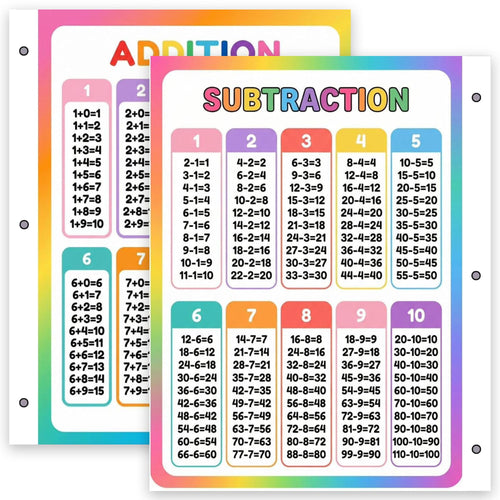
- The Addition & Subtraction Facts Chart is a laminated, double-sided binder insert kids can write on directly with a dry-erase marker and wipe clean, built for the "ten quick reps" habit above.
- The Multiplication & Division Reference Insert covers the next stage, with pack sizes for a whole class or co-op.
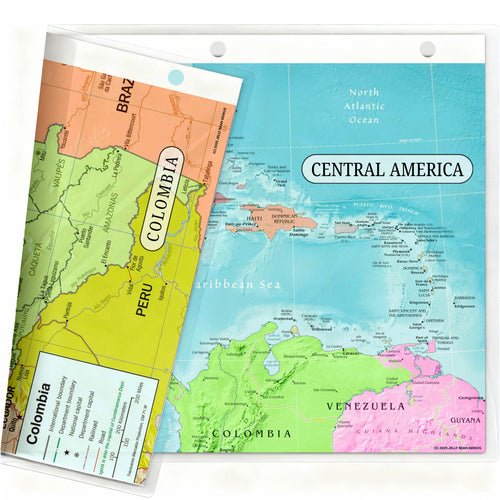
- Browse the full math learning charts collection for place-value, fractions, and more, or the study maps and educational placemats if you want the practice built into the table where kids already sit.
If you're new to wipe-clean tools generally, our guide to reusable dry-erase learning tools covers how to fold them into a routine across subjects. Everything lives in the binder inserts collection.
What are the most common hands-on math mistakes to avoid?
The activities work, but a handful of common missteps quietly undo them. Watch for these five:
- Moving to symbols too fast. The most frequent mistake is treating manipulatives as a quick warm-up before the "real" worksheet. The concrete stage is the real work; rushing past it just hides the gap. Let the child stay concrete until the idea is genuinely solid.
- Never letting the tool fade. The opposite error: a child still counting every object at an age when facts should be automatic. Manipulatives are training wheels, plan to take them off once a skill is reliable.
- Using objects as toys, not tools. If the counting bears become a zoo, gently redirect. A clear, single-purpose tool like a dry-erase chart invites far less off-task play than a bin of loose parts.
- Correcting instead of asking. When an answer is wrong, resist supplying the right one. Ask "show me with the blocks" and let the child find it. That self-correction is where the learning lands, and it's exactly why the wipe-and-retry loop of a reusable chart works so well.
- Going long and infrequent. One marathon session teaches less than short daily reps, which is the last question worth answering.
Avoid those five and the activities above do their job.
How much hands-on math practice do kids actually need?
Short and frequent beats long and occasional. Ten to fifteen focused minutes most days builds more fluency than a single long weekend drill, because spacing practice out is what moves a skill into long-term memory.
Three rules keep it sustainable:
- Keep sessions short. End while the child still has appetite for it. A clean, wipe-and-done chart makes "just ten more" easy to say yes to.
- Return to the same skill until it's automatic, then let the tool fade.
- Follow the child's cues. Frustration means the current step is too abstract, drop back to the concrete version. Boredom means it's time to fade the support.
Do that, and math stops being the subject kids dread and becomes the one they can see.