If you've spent any time in baby-feeding groups, you've probably seen the challenge: help your baby try 100 different foods before their first birthday. It's playful, motivating, and surprisingly practical, a simple way to keep track of the flavors and textures you're offering during a busy, blurry first year. Here's what the challenge actually is, when to start, and the easiest way to keep score. First, the important part: this is a fun tracking game, not a medical program, always follow your pediatrician's guidance on when and what your baby is ready to eat.
What is the 100 Foods Before One challenge?
The 100 Foods Before One challenge, sometimes called "100 first foods", is a popular approach in baby-led weaning and first-foods communities. The idea is simple: over your baby's first year, aim to introduce around 100 different foods, and keep a running list of everything they try.
Here's the part that matters most: the goal isn't that every baby must eat exactly 100 foods. It's not a competition or a medical target. The number is a fun, motivating milestone that nudges you toward variety, a wide range of flavors, textures, and food groups, instead of the same handful of purees on repeat. Think of it as a game that happens to build good habits, not a rule you can pass or fail.
It's also not a substitute for professional guidance. Every baby develops on their own timeline, so treat the challenge as a tracking tool layered on top of your pediatrician's advice, especially for when to start, what textures are safe, and how to handle allergens. Throughout the first year, breast milk or formula stays your baby's main source of nutrition; solids are for practice, exposure, and fun.
When can babies start solid foods?
Most babies are developmentally ready for solid foods around six months, while continuing breast milk or formula as their primary nutrition. But age is only part of it, readiness is really about development. Common signs a baby may be ready include:
- Sitting up with good head and neck control
- Showing genuine interest in food (watching you eat, reaching for it)
- Losing the tongue-thrust reflex that pushes food back out
- Being able to bring hands and objects to their mouth
Because readiness varies, the safest first step of the challenge is a conversation with your pediatrician, confirm your baby is cleared for solids, and ask about their specific needs before you offer that first bite. Don't rush to start the list; the challenge works just as well begun at six or seven months as at five.
Why variety matters in your baby's first year
The whole point of the challenge is variety, and there's a nice logic to it. Exposing babies to many different tastes and textures early, when they tend to be more open, can make mealtimes easier down the road, and it helps you cover a broad nutritional base. Aim to rotate through:
| Group | Examples to work toward |
|---|---|
| Vegetables | Sweet potato, broccoli, peas, carrot, zucchini, spinach |
| Fruit | Banana, avocado, pear, blueberry, mango, kiwi |
| Proteins & iron-rich foods | Well-cooked egg, beans, lentils, soft meats, tofu |
| Whole grains | Oats, brown rice, whole-grain toast strips |
| Dairy (as appropriate) | Plain yogurt, cheese |
Colors, textures, and flavors all count as "new", roasted carrot and steamed carrot can each be their own little win. The variety is what makes the challenge fun, and it's a genuinely nice family activity: you end up cooking a little more adventurously too. Keep portions tiny, follow safe-texture guidance for your baby's stage, and let your baby set the pace.
What about common allergens?
This is the part parents ask about most, and it's worth getting right. Pediatric guidance has shifted in recent years: rather than delaying allergens, many families are now advised to introduce common allergens early and one at a time, which may help reduce the risk of some food allergies. This is exactly where you follow your pediatrician's advice, especially if your baby has eczema or a family history of food allergies, where a doctor may recommend a specific plan.
The common allergens to introduce thoughtfully include milk, egg, peanut (in an age-appropriate form, never whole nuts), tree nuts, soy, wheat, fish, shellfish, and sesame. A few practical habits most guidance shares:
- Introduce one new allergen at a time, so a reaction is easy to trace.
- Offer it earlier in the day, not right before bed, so you can watch your baby.
- Wait a few days before adding the next new allergen.
- Know the signs of a reaction and your pediatrician's plan if one happens.
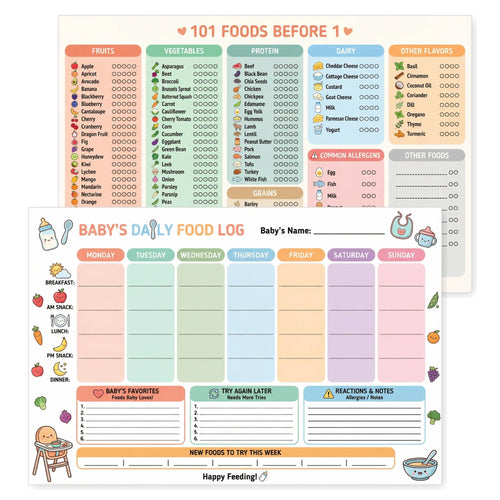
This is where a written tracker really earns its place: noting the date you introduced each allergen and any reaction gives you and your pediatrician a clear record. Our Baby Food Introduction & Allergen Tracking Chart is built for exactly this, but the medical plan is always your pediatrician's call.
How a food tracker keeps you organized
The hardest part of the first year isn't cooking, it's remembering. "Did we already try kiwi?" "Was it broccoli last month, or am I thinking of peas?" "Which allergens have we done?" Somewhere around food number thirty, it all blurs together.
A visible tracker solves that in the simplest possible way. Everything your baby has tried is right there where you can see it. You just:
- Check it off when your baby tries a new food.
- Write the date you introduced it.
- Note the reaction, loved it, made a face, or a possible allergy flag.
- Circle the favorites so you remember the wins.
No app to open, no battery to charge, no login, just a glance at the refrigerator. For a sleep-deprived parent, "always visible" beats "technically in an app somewhere" every time. The 101 Foods Before 1 dry-erase tracker gives you 101 foods laid out and ready to check off, so you're never starting from a blank page.
Why a dry-erase tracker beats a paper checklist
A printable paper checklist works, until it doesn't. It's one-and-done: it gets splattered, crossed out, tucked in a drawer, and eventually tossed. If you want to run the challenge again for a second child, you print a new one.
A laminated dry-erase tracker flips all of that:
- Reusable. Wipe it clean and start fresh for the next baby.
- Forgiving. Made a mistake or want to move a note? Just erase it.
- Durable. It lives on the fridge through spills and sticky hands.
- A keepsake. Snap a photo at food #100 before you wipe it, an easy first-year memory.
Because it's the same wipe-clean, reusable approach behind our other dry-erase learning tools, one tracker covers your whole first year, and every child after.
How to start the 100 Foods challenge this week
You can start the challenge in an afternoon. Here's a simple rhythm that keeps it low-pressure:
- Get your pediatrician's OK that your baby is ready for solids, and ask about any specifics for your child.
- Hang the tracker where you'll see it, the refrigerator is perfect.
- Offer one or two new foods at a time, in a safe texture for your baby's stage, and watch how they do (especially with allergens).
- Check it off, date it, and jot the reaction right after.
- Re-offer foods they refuse. A "no" isn't final, many foods take repeated tries before a baby accepts them, so keep calmly offering.
- Keep it relaxed. Never force a food. Let your baby lead, and remember the number is a milestone, not a deadline.
Making it a keepsake, and reusing it for siblings
When you reach the last square, you don't have to stop there. Many parents snap a photo of the finished tracker as a first-year milestone, then wipe it clean and start over for the next baby, no reprinting, no clutter.
If you want the whole feeding year covered, the Baby Feeding Poster Set (4-Pack) pairs the 101 Foods tracker with three companions: the allergen tracking chart, a mealtime routine poster with safe food shapes and sizes, and a baby sign-language poster for reading hunger and fullness cues. Browse the full range in educational decor. However you play it, the 100 Foods challenge does one quietly useful thing: it turns a hectic first year of feeding into something you can see, celebrate, and remember.
Disclaimer: This article is general educational information, not medical advice. Every baby is different. Always talk to your pediatrician about when and what to feed your baby, safe textures, and how to introduce allergens.