Most children can name the first president and the current one. The forty or so in between are where it falls apart, and that is no surprise: a list of 47 names is far too long to memorize as one block.
The fix is the same one teachers use for the times tables. Break the list into chunks, give each chunk a landmark, and practice out loud. This guide walks through that method, answers the questions children always ask (why is Cleveland on the list twice?), and finishes with Presidents' Day ideas for February.
What does the President actually do?
The President leads the executive branch, the part of the government that carries out the laws. The USAGov page on the president lists three roles: head of state, leader of the executive branch, and commander in chief of the armed forces.
For young children, one sentence works: Congress makes the laws, and the President's job is to make sure they are carried out. The President also signs or vetoes bills, meets leaders of other countries and chooses people for the Cabinet and the courts. Our three branches of government guide covers how the other two branches check the President, and the Three Branches of Government poster shows where the executive branch sits.
Who can become President?
Three rules, all in Article II of the Constitution. A President must be:
- a natural born citizen of the United States,
- at least 35 years old, and
- a resident of the United States for at least 14 years.
You can show children the exact wording in the National Archives transcript of the Constitution, where the age rule is written out as "thirty five Years."
A fourth rule came later. The 22nd Amendment, ratified in 1951 according to the National Archives text of Amendments 11 to 27, says no person can be elected President more than twice. Children usually ask why, which is a good opening for a talk about why the framers worried about any one person holding power too long.
Why are there 47 presidents but only 45 people?
Because two presidents served two terms that were not back to back, and each term gets its own number.
Grover Cleveland was the 22nd President from 1885 to 1889, lost the next election, then won again and served as the 24th from 1893 to 1897, as the Miller Center's Grover Cleveland biography records. Donald Trump is the second: the Miller Center lists him as President number 45 and 47, with terms beginning in 2017 and 2025.
This trips up adults too. Ask "who was the 24th president?" and the answer is Cleveland, again. On a timeline wall, he gets two posters, numbers 22 and 24, with Benjamin Harrison in between, and the same goes for numbers 45 and 47. Our Grover Cleveland poster carries both numbers on one sheet, which makes a neat talking point on its own.
How do kids learn the presidents in order?
Split the 47 into six eras of five to eleven numbers each, then learn one era a week. Each era starts with a name most children already know, which gives them a hook.
| Era | Numbers | Start with | Why this break works |
|---|---|---|---|
| The founders | 1 to 7 | George Washington | Washington through Andrew Jackson, the first generation of the republic |
| Before the Civil War | 8 to 15 | Martin Van Buren | The hardest era for kids, eight short terms in a row |
| Civil War and after | 16 to 25 | Abraham Lincoln | Lincoln through McKinley, with Cleveland twice |
| A new century | 26 to 31 | Theodore Roosevelt | The early 1900s through the start of the Great Depression |
| Depression, war and the 1960s | 32 to 36 | Franklin D. Roosevelt | Roosevelt through Lyndon B. Johnson |
| Modern presidents | 37 to 47 | Richard Nixon | Nixon to today, the names children hear at home |
Two tips from the way this usually goes. First, say the names in groups of three or four with a pause, the way you would read a phone number: "Washington, Adams, Jefferson. Madison, Monroe, Adams." The rhythm carries more than the names do. Second, let children skip ahead to the modern era if that is what they care about. Most children learn the recent names first anyway, and working backwards from the present is as valid as starting in 1789.
The era that causes the most trouble is the one before the Civil War, numbers 8 to 15. Eight presidents served in about twenty years, and several of them are names children have never heard. Spend a little longer there, and pair each name with one fact from its poster. Our individual posters for the 6th president, John Quincy Adams, and the 9th, William Henry Harrison, are two that families look up most.
What games help kids learn the presidents in order?
Physical games beat flashcards, because children remember where a name sat as well as the name itself.
- The clothesline. String twine across a wall and clip numbered cards to it. Children add a name card under each number as they learn it. Start with one era, 1 to 16 makes a good first line, ending on Lincoln.
- Human timeline. Hand out president cards in random order and have the class line up by number without talking. Then read the line aloud.
- Who am I? Read three clues from a president's poster, hardest first, and see how few clues each team needs.
- Before or after? Name two presidents and ask which came first. It tests the order without demanding the whole list.
- Count the gaps. On a wall timeline, cover three posters and ask who is missing.
The human timeline works with as few as five cards, so it suits a homeschool family as well as a full class.
Which posters build a presidents wall?
One poster per presidency, in a row, is the classic timeline wall, and it is what the eras above are designed around.
The US Presidents 47-Piece Poster Set gives you every numbered presidency from Washington to the 47th as matching 8.5 by 11 inch laminated posters, each with a portrait, years in office and short facts. The American Presidents Complete Set adds a 48th sheet, "Who's Next?", that leaves room for the next President.
If you would rather build the wall one era at a time, every president is also sold on his own in the presidents and American history collection, so you can start with the founders and add a row each month. Our history classroom setup ideas cover where a presidents timeline fits beside a civics wall, and the civics and history reference library lists the other pages worth keeping close.
Who will be the 48th President?
Nobody knows yet, which is what makes it fun. The next presidential election is in November 2028, and under the 20th Amendment the new term begins at noon on January 20, 2029. The 48th President poster is a "Who Will Be Next?" sheet that walks through how a President is elected, and our guide to how elections work for kids explains primaries, conventions and the Electoral College in kid words.
When is Presidents' Day, and what is it really called?
Presidents' Day falls on the third Monday in February. In 2027 that is Monday, February 15, according to the OPM federal holiday schedule.
Its official name is Washington's Birthday. The National Archives history of Washington's Birthday explains that Congress made February 22 a holiday in 1879, then the Monday Holiday Law of 1968 moved it to the third Monday in February. That means it can never land on Washington's real birthday, since the third Monday cannot fall later than February 21. The Archives also notes that neither Congress nor any President has ever changed the name to "Presidents' Day." Children enjoy that one.
Four ideas for the week:
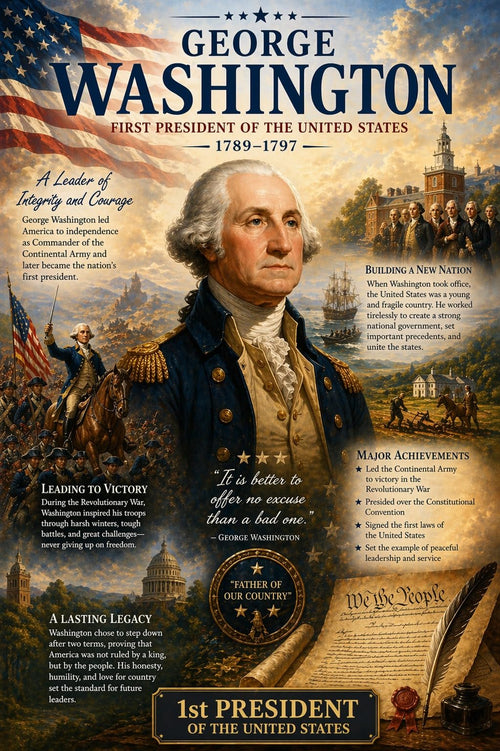
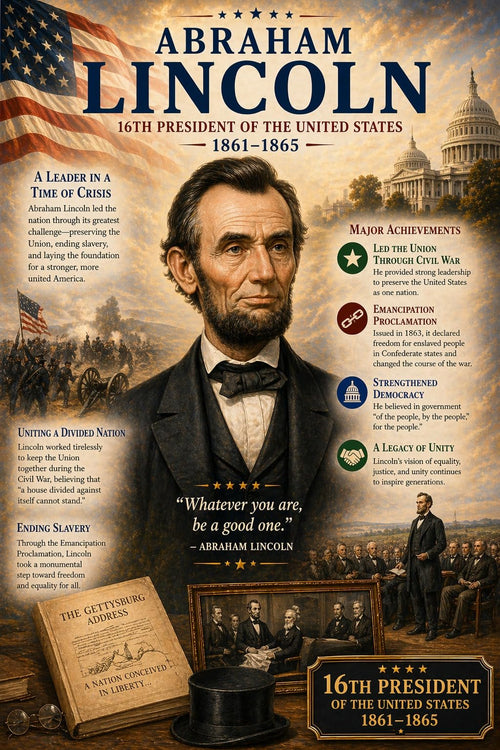
- Washington and Lincoln side by side. Put the George Washington and Abraham Lincoln posters up together and have students list what the two had in common.
- Run the human timeline with just the presidents learned so far.
- Write to the 48th. Each child writes a short letter to the next President, whoever that turns out to be, about one thing they hope gets better. Seal them until January 2029.
- One president, one fact. Each student draws a number from a hat and shares one fact from that poster the next morning.
How do you teach the presidents at home?
One era a week, one binder page and five minutes at dinner.
The Presidents and Vice Presidents reference page is a laminated, hole-punched sheet with every president in order on the front and every vice president on the back, so it lives in a binder and goes wherever the lesson does. That is what most people searching for a "presidential binder" are after. Our homeschool binder setup guide shows how we would organize a social studies section around it, next to the Bill of Rights study charts.
At home, the before-or-after game works anywhere: in the car, at dinner, in line at the store. Name two presidents and let your child say which came first. A month of that and most children can place a name within an era without looking.