Ask a five-year-old where a penguin lives and you will hear "the cold." Ask where a cow lives and you will hear "a farm." Children already sort animals by home without knowing the word for it. A habitat unit just gives that instinct a name, a map and a reason.
This guide covers what a habitat is, the six habitats children usually learn first, the grade each idea shows up in, and ten activities that work from preschool to fourth grade. Everything here works with a classroom of twenty-five or one child at the kitchen table.
What is an animal habitat?
A habitat is the place where an animal makes its home, and it has to provide everything that animal needs to survive. National Geographic Education's entry on habitats defines a habitat as "a place where an organism makes its home" and names its main parts as shelter, water, food and space. The National Wildlife Federation's habitat essentials page uses a slightly different list of four: food, water, cover, and places to raise young.
For children, the simplest version is a question with four parts. Where does it eat? Where does it drink? Where does it hide? Where does it raise its babies? If a place answers all four for an animal, that place is its habitat. If it misses one, the animal cannot live there for long, which is the idea every activity below comes back to.
What are the main animal habitats kids learn first?
Most early science programs start with six: the ocean, the tropical rainforest, the savanna, the forest, the desert and the polar regions. Some teachers add wetlands, grasslands or mountains later, but these six are different enough from each other that children can feel the contrast.
| Habitat | What it is like | Animals to start with |
|---|---|---|
| Ocean | Salt water, from sunny shallows to the dark deep sea | Blue whale, octopus, sea turtle, clownfish |
| Tropical rainforest | Hot, wet and green, with very tall trees in layers | Jaguar, sloth, toucan, tree frog |
| Savanna | Warm grassland with scattered trees, a wet season and a dry season | Lion, elephant, giraffe, zebra |
| Forest | Trees that change with four seasons, cold winters | Deer, red fox, black bear, owl |
| Desert | Very little rain, hot days and often cold nights | Roadrunner, scorpion, tarantula, meerkat |
| Polar | Ice, snow and freezing water for much of the year | Penguin, walrus, narwhal, seal |
The ocean is the biggest by far. About 71 percent of Earth's surface is covered by water, and the oceans hold about 96.5 percent of all Earth's water, according to the U.S. Geological Survey's Water Science School. It is also the least explored. As of April 2026, only 28.7 percent of the global seafloor had been mapped in high resolution, and people have seen less than 0.001 percent of the deep ocean floor, says NOAA Ocean Exploration. That last number is worth writing on the board. Children love the idea that the biggest home on the planet is mostly still a mystery.
Why do animals live in different habitats?
Animals live where their bodies and habits fit. A polar bear's thick fur and layer of fat keep it warm on the ice and would make it miserable on the savanna. A sloth's long curved claws hold it in rainforest branches and are no use in the open ocean. Scientists call these fits adaptations.
The easiest way to show this is to pick two animals from opposite habitats and ask children to swap them. "What would happen to a penguin in the desert? What would a camel do at the South Pole?" Five-year-olds will give you the right answer for the wrong reasons, and nine-year-olds will give you a list of body parts. Both are doing science.
What grade do kids learn about habitats?
In schools that follow the Next Generation Science Standards, habitats come up in kindergarten, second grade and third grade, each time with a harder question.
- Kindergarten. Standard K-ESS3-1 asks children to "use a model to represent the relationship between the needs of different plants and animals (including humans) and the places they live." Its own example is that deer eat buds and leaves, so they usually live in forested areas.
- Second grade. Standard 2-LS4-1 asks students to "make observations of plants and animals to compare the diversity of life in different habitats." Notice that the standard says assessment does not include specific animal names in specific habitats. The point is noticing variety, not memorizing lists.
- Third grade. Standard 3-LS4-3 asks students to "construct an argument with evidence that in a particular habitat some organisms can survive well, some survive less well, and some cannot survive at all."
Preschool is not in the standards, but it is where the sorting instinct is strongest, so the first activities below are written for three to five year olds.
What are the best habitat activities for kids?
Hands-on ones that make children decide where an animal belongs and say why. Here are ten, with the age each suits best.
| # | Activity | Best for | Time |
|---|---|---|---|
| 1 | Habitat sort on paper plates | Preschool to K | 15 min |
| 2 | Point and name | Preschool to K | 5 min |
| 3 | Habitat sensory bins | Preschool to K | 20 min |
| 4 | Four questions check | K to 2 | 15 min |
| 5 | Shoebox habitat | K to 3 | Two sessions |
| 6 | Animals that live in two places | 1 to 3 | 20 min |
| 7 | Schoolyard habitat survey | 2 to 4 | 30 min |
| 8 | Habitat swap debate | 3 to 4 | 30 min |
| 9 | Design an animal | 2 to 4 | 40 min |
| 10 | Habitats on the world map | 2 to 4 | 30 min |
Which habitat activities work for preschool and kindergarten?
At this age, keep it to sorting, naming and touching, one habitat at a time.
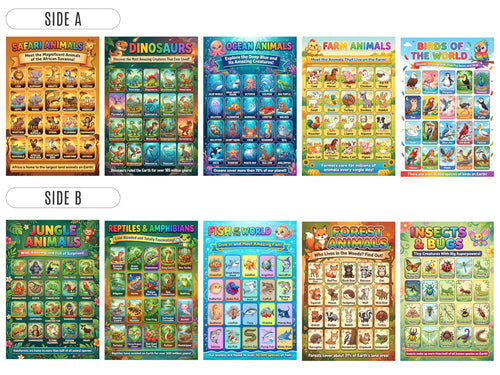
1. Habitat sort on paper plates. Color six paper plates, blue for ocean, dark green for rainforest, yellow for savanna, light green for forest, tan for desert and white for polar. Hand out animal picture cards and let children place each one on a plate. The Birds and Insects poster is a good source of cards, because its twenty birds cover almost every habitat: the penguin goes to polar, the toucan and macaw to rainforest, the roadrunner to desert, the ostrich to savanna, the puffin and pelican to the ocean edge.
2. Point and name. Hang one poster side at child height and play "I spy an animal that lives in the water." Children walk up and point. It takes five minutes and works every morning of a habitat week.
3. Habitat sensory bins. Blue water beads or plain water for the ocean, sand for the desert, crinkled green paper for the rainforest, and cotton balls or ice cubes for polar. Toy animals go in the bin they belong to. Ice melting in the polar bin starts a good conversation about why polar animals need cold.
For the youngest learners, the Ocean Animals Learning Posters set pairs one habitat with letters, colors, numbers and first words on a dry-erase surface, so a week on the ocean can double as alphabet practice.
Which habitat activities work for older kids?
From first grade up, children can test a habitat against the four needs, argue about edge cases and connect habitats to the map.
4. Four questions check. Pick a habitat and an animal. Children answer the four questions from the National Wildlife Federation list: where does it find food, water, cover, and a place to raise young? A deer in the forest gets four yes answers. A deer in the ocean gets none.
5. Shoebox habitat. Each child or pair builds one habitat inside a shoebox turned on its side: painted background, a water source, a hiding place, and two or three animals drawn, cut out and stood up with tape. Before they start, they must show you where each of the four needs is in the box. It takes one session to build and one to present.
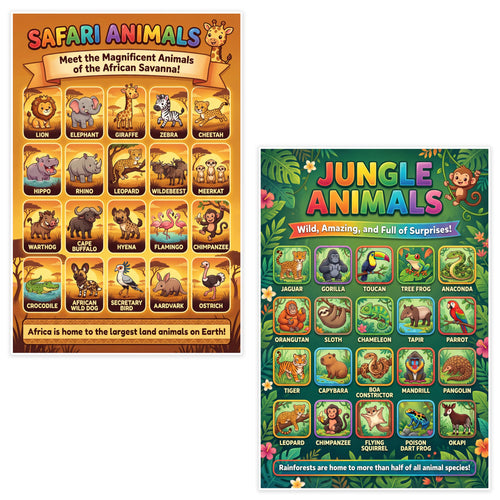
6. Animals that live in two places. Some animals do not fit one plate. On our posters, the turkey and the rabbit appear on both the Farm and the Forest sides of the Farm and Forest Animals poster, and the chimpanzee and the leopard appear on both the Safari and the Jungle sides of the Safari and Jungle Animals poster. Ask students to find the repeats and explain how one animal can live in two habitats. The answer, that some animals can meet their four needs in more than one kind of place, is the whole idea of adaptation in a sentence.
7. Schoolyard habitat survey. Take clipboards outside and look for food, water, cover and places to raise young: a puddle, a bush, a bird's nest, seeds on the ground. Mark each on a rough map of the yard. Students are usually surprised by how much habitat is hiding next to the parking lot.
8. Habitat swap debate. This is the third grade standard as a game. Give each group one animal and one habitat it does not belong in, such as a narwhal in the desert or a camel in the rainforest. The group argues, with evidence from the animal's body and needs, whether it would survive well, survive less well or not survive at all. Then flip it and argue the animal's real home.
9. Design an animal. Assign a habitat and have students invent an animal for it, then label every adaptation: big ears to lose heat in the desert, webbed feet for the ocean, white fur for the snow. It is the reverse of everything above, and it shows whether a child really understands why animals fit where they do.
10. Habitats on the world map. Put sticky notes on a world map for each habitat: the Amazon rainforest, the African savanna, the Sahara, Antarctica, the Pacific. Children start to see that habitats follow the map, with rainforests near the equator and ice at the poles. Our guide to teaching kids the continents uses animals as anchors for each continent, and the best world maps for classrooms covers which map holds up to daily sticky notes and dry-erase markers.
Is a farm a habitat?
Yes, but it is a habitat people made. A farm gives cows, sheep and chickens food, water, shelter and a place to raise young, so it meets the definition. The difference is that farmers provide most of it, and many farm animals would struggle without that help.
That makes the Farm and Forest poster a useful pair of sides to compare. Put the farm side next to the forest side and ask: which animals here get food from a person, and which find it themselves? A white-tailed deer and a cow both eat plants, but only one of them waits for a farmer. Children who live near farms often have strong opinions here, which is exactly what you want.
How do you set up a habitat wall in a classroom?
Give each habitat its own space on the wall, label it in big letters, and leave room underneath for student work.
A simple layout: a banner across the top reading ANIMAL HABITATS, one poster side per habitat below it in a row, and a strip of paper under each for the animal cards children sort during the week. The Ocean Animals and Fish poster covers the ocean, the Safari side covers the savanna, the Jungle side covers the rainforest and the Forest side covers the forest. Desert and polar animals are spread across the posters, so those two strips start empty and fill up as students find the roadrunner, the scorpion, the penguin and the walrus. Hang the posters at children's eye level, not teacher eye level, and keep a world map close by.
Our classroom setup ideas cover where a science wall fits beside reading and math spaces.
How do you teach habitats at home?
One habitat a week and one short activity a day is plenty.
Start with the habitat your child is most excited about, often the ocean or the rainforest, and hang that poster side in the kitchen or by the bed. Read one picture book about it, do the paper plate sort or the sensory bin, and finish the week with a walk outside looking for the four needs in your own yard or park. Then flip the poster and start the next one. Our homeschool binder setup guide shows how to keep animal cards and drawings together as the units add up.
A zoo or aquarium visit lands much harder after a habitat week. Before you go, pick three animals from the poster and challenge your child to find each one and say which habitat its enclosure is copying.
Which posters help kids learn animal habitats?
Posters that group animals by where they live, so the habitat is visible before a child reads a word.
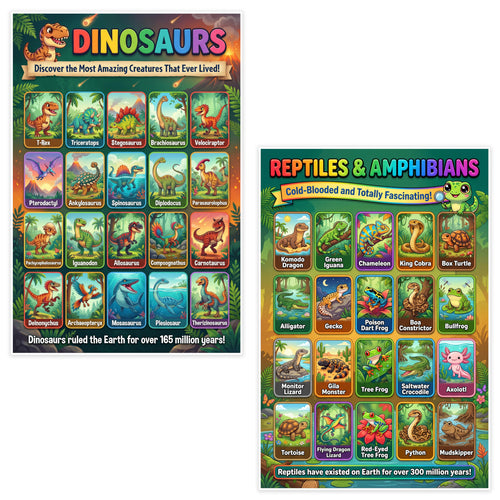
The Animal Posters 5-Pack has ten designs on five double-sided 11 by 17 inch laminated posters: Safari and Jungle, Ocean Animals and Fish of the World, Farm and Forest, Birds of the World and Insects and Bugs, and Dinosaurs and Reptiles and Amphibians. That is two hundred labeled animals, and every activity in this guide can be done with it. Each poster is also sold on its own, including the Dinosaurs and Reptiles poster for a lesson on how the places animals live have changed over time.
Browse the full animal kingdom collection, or the wider science collection, which includes the human body posters from our human body systems guide.