A calm down corner works best when it is simple, predictable, and easy to use in the middle of a real day. It does not need to look like a catalog photo. It does not need a giant basket of sensory toys. The goal is much more practical: give a child a safe place to pause, name what is happening in their body, try one regulation strategy, and return to learning with less friction.
That is why calm corners have become such a big topic for teachers, homeschool parents, therapists, and families. Classrooms are busy. Homes are busy. Kids move from handwriting to math to screens to snacks to transitions, and their nervous systems do not always keep up neatly. A small corner with the right visual prompts can turn a difficult moment into a teachable routine. It gives adults a script and gives children something concrete to follow.
The best calm down corner is not a reward center or a punishment spot. It is a regulation station. Kids should understand that using it is normal, not embarrassing. They are not being sent away from the group because they are bad. They are being supported while they learn how to reset. That difference matters, especially for children who already feel big emotions quickly.
Start with the routine, not the stuff
Before you buy anything or print anything, decide how the calm corner should work. A good routine might be: notice the feeling, choose a calm strategy, try it for one to three minutes, check your body, then return to the activity. When the steps are clear, children do not have to guess what is expected of them. This is where visual supports are useful, because they keep the adult from needing to explain everything every time.
For younger children, the routine may need adult coaching. A teacher might say, "Your hands are tight and your voice is loud. Let's try three square breaths." A parent might say, "I can see this feels frustrating. Pick one strategy, then we will come back to the worksheet." Over time, the same language becomes familiar. The child starts to connect body signals with a next step.
If the corner is in a classroom, keep it visible to the adult. It should feel private enough to reduce pressure, but not hidden. If it is at home, place it near the area where learning or homework happens, not in a bedroom on the other side of the house. The easier it is to use in the moment, the more likely it becomes part of daily life.
Keep choices small
One common mistake is filling a calm corner with too many options. A basket with fifteen fidgets, three timers, five books, a plush pile, coloring pages, and reward cards can quickly become more stimulating than the original problem. Children who are already dysregulated often struggle to choose. Less is usually better.
A practical setup might include one comfortable seat or floor cushion, one feelings chart, one breathing visual, one grounding visual, a small timer, tissues, and a clipboard. That is enough to create a rhythm without turning the corner into another activity center. If a tool does not help the child return to learning, it does not belong in the first version.
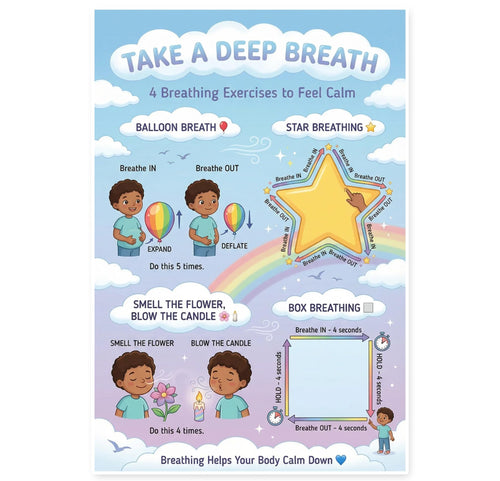
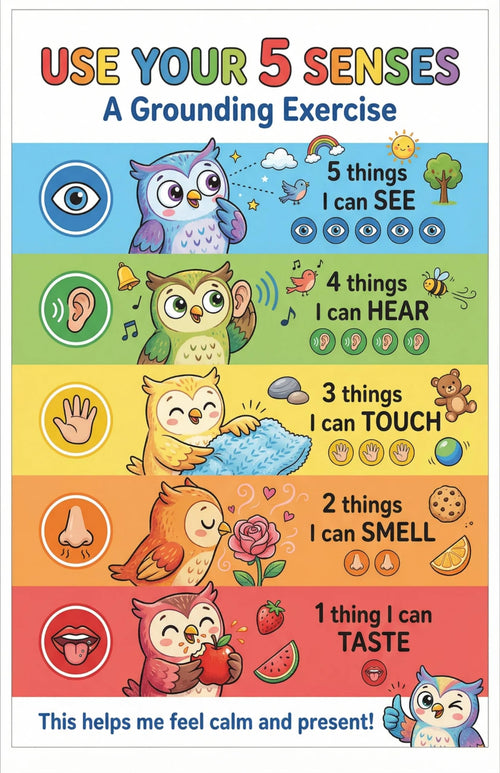
Jelly Bean Genius keeps this idea in mind across the Calming Corner collection. The aim is not to overwhelm walls with decoration. It is to make the next step obvious. A child can look at a breathing poster and copy the pattern. They can look at a grounding poster and search for what they can see, hear, feel, smell, and taste. The visual does part of the coaching for you.
Use posters as prompts, not wallpaper
Calm visuals are most powerful when children are taught how to use them. Hang a poster at kid eye level and practice it during a calm moment. Do not wait until a meltdown to introduce the routine. During morning meeting, a homeschool warmup, or the first five minutes of class, choose one strategy and try it together. Make it ordinary.
The Calm Down Corner Posters for Kids 4 Pack gives you a small set of regulation choices without making the wall feel crowded. Square breathing, grounding, bear hug breathing, and superhero power pose are easy to model with a whole group. Once children have practiced each option, they can choose the one that feels right when they need it.
The 5-4-3-2-1 Grounding Poster is especially useful when a child feels scattered, worried, or stuck in a loop. It brings attention back to the room through the senses. This is helpful because children often need something more concrete than "calm down." They need a thing to do with their eyes, hands, breath, and attention.
Teach the difference between calming and avoiding
A good calm corner should not become a hiding place from every difficult task. The purpose is to support regulation so children can return. That means the routine needs a simple end point. You can use a visual timer, a one-strategy rule, or a check-in card. The exact method matters less than the shared expectation: we pause, we reset, we come back.
For classrooms, it helps to introduce the corner before anyone needs it. Talk about what it is for and what it is not for. It is for big feelings, body resets, breathing practice, grounding, and quiet moments. It is not for playing, skipping work, or getting extra attention. Keep the tone neutral. Children should not feel shamed for using it, and they should not feel like it is a prize.
At home, the same idea applies. A calm space can be part of homework time, morning transitions, bedtime routines, or after-school decompression. Some children need to move before they can sit. Others need to breathe before they can talk. Build the routine around what actually helps the child return to the next step.
Make it age-flexible
One reason Jelly Bean Genius products use broad age ranges is that a visual tool can serve different children in different ways. A preschooler might use an emotion chart to point at a face. An elementary student might use it to choose a word. A middle school student might use the same chart as a private prompt before writing a reflection. The tool is simple, but the adult use can grow with the child.
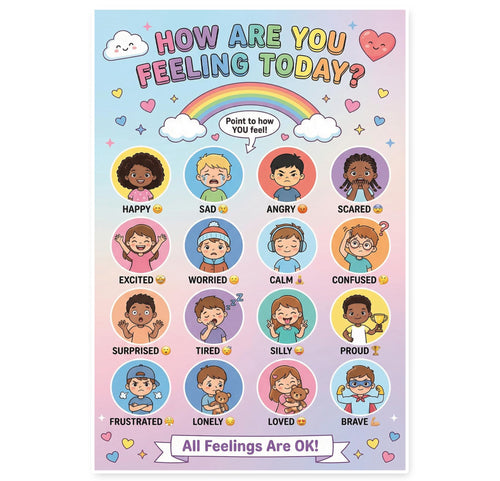
For younger kids, keep the language direct: mad, sad, worried, excited, tired, calm. For older kids, add more nuance: embarrassed, disappointed, overwhelmed, frustrated, proud. You can pair a feelings chart with a quick sentence frame: "I feel blank because blank. I can try blank." That makes the corner more than a place. It becomes a routine for emotional vocabulary.
The 16 Emotions Feelings Chart is a useful anchor for that work. It gives children a visual menu of feeling words, which can be easier than asking them to produce a label from memory. In classrooms, it can sit near morning check-in. At home, it can live near a homework table or reading corner.
Build a small calm corner kit
If you are setting up from scratch, start with a tiny kit and improve it after a week. Include a floor spot, a timer, one breathing poster, one grounding poster, one emotion chart, and a small card that says what happens next. If you teach in multiple rooms or homeschool in different spaces, put the kit on a clipboard or inside a folder so it can travel.
A sample routine might look like this: choose one feeling, choose one strategy, set the timer, do the strategy, take one sip of water, then return. For some children, that will be enough. For others, you may need to add a co-regulation step with an adult. The important part is consistency. Kids learn the rhythm because the adult keeps the rhythm steady.
When the corner starts working, resist the urge to keep adding. A calm corner does not need to become a theme wall. It needs to stay clear. If you want to make it warmer, add one soft element, one plant, or one simple sign. Leave white space around the posters so children can visually find what they need.
Shop the calm corner idea
For a quick starter setup, browse the full Calming Corner collection. If you want a wider wall setup, look through Educational Decor for posters that turn blank wall space into useful learning support. Teachers planning a full room can also visit For Teachers for classroom-friendly options and bulk support.
If you are not sure where to start, choose one emotion visual and one regulation visual. Practice them when everyone is calm. Then keep the routine boring, kind, and consistent. That is usually what makes a calm down corner actually work.
Quick FAQ
Do calm down corners work for every child? Not in exactly the same way. Some children need movement first, some need quiet, and some need an adult nearby. A calm corner gives you a structure, but you can adjust the tools inside it.
Should a calm corner be used for discipline? No. It should be framed as support. If the child experiences it as punishment, the corner may become another source of stress instead of a reset.
How many posters should I use? Start with two or three. A feelings chart, a breathing visual, and a grounding visual are enough for most first setups. You can rotate later if students need more variety.
Can this work at home? Yes. Home calm corners can be even simpler. A chair, a feelings chart, and one breathing poster near the homework area can create a predictable pause point.
What should I do if kids play in the calm corner? Re-teach the routine during a neutral moment. Keep materials minimal, use a timer, and make the return-to-learning step clear.
How to use this this week
The easiest way to turn this idea into action is to pick one small routine and repeat it for five days. Do not rebuild the whole room, rewrite the whole lesson plan, or buy every possible material at once. Choose the part of the day that already needs support and place the visual tool there. Morning warmups, small-group rotations, homework time, quiet reading, and end-of-lesson review are all good candidates because children already expect a routine in those moments.
On day one, model the routine yourself. On day two, let a child help. On day three, ask students to explain the steps back to you. On day four, use the tool with a slightly harder prompt. On day five, keep the tool available and notice whether children reach for it with less adult direction. That simple progression gives the visual a real job instead of leaving it as another nice-looking item on the wall.
If you are teaching a group, write the prompt on the board before students arrive. If you are using the idea at home, put the prompt on a sticky note beside the material. The less you have to explain in the moment, the more likely the routine is to happen. Small routines are where calm corner practice starts to feel natural.
A one-week calm corner launch plan
Day one should be pure introduction. Show the space, name the tools, and practice one strategy when nobody is upset. Day two can be a group rehearsal: everyone tries the breathing visual for thirty seconds and notices what changes in their body. Day three can add the feelings chart. Ask children to point to one feeling they have had this week and choose a strategy that might help. Day four can be a role-play with an easy scenario, such as frustration over a tricky worksheet. Day five can be independent practice, with the adult nearby but not doing all the talking.
After the first week, keep watching how the space is used. If children avoid it, the routine may feel unclear or too public. If children overuse it, the return step may need tightening. If children play with the materials, remove anything that does not directly support regulation. Small adjustments are normal. The goal is not a perfect corner on day one. The goal is a calm, repeatable routine that children understand.